Shrinkage Cracks
Concrete shrinks as it cures and dries. Hairline cracks appear, often in random patterns or from corners, within the first months.
They are cosmetic in almost all cases. Once the slab is fully cured, they usually stop moving.
Repair & structural
Patching a crack that is still moving is throwing money away. Kitchener Prestige Flooring diagnoses and repairs cracked concrete, spalled garage floors, chipped tile and failed joints for homeowners, businesses and property managers across Kitchener and Waterloo Region.
In more than 16 years and 1,700+ flooring jobs, we have seen the same crack patched three times by others because nobody asked why it formed. We find the cause first, then choose a repair that will hold.
Our crew is licensed, insured and WSIB covered. Crack and chip repairs carry our written 1-year labour warranty, and we will tell you if a crack needs an engineer instead of a flooring contractor.
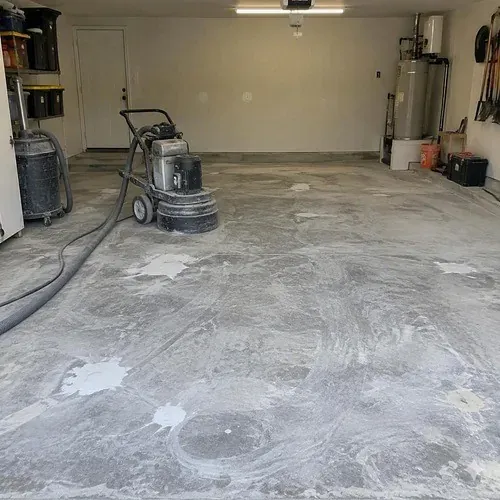
A crack is a message. It tells you where and how a slab or substrate has moved.
A crack that has stopped moving can be bonded shut and forgotten. A crack that is still opening and closing with the seasons will break any rigid patch, usually right beside the repair.
We check width, displacement and history, and sometimes monitor a crack for a few weeks before choosing a fix. That step is what makes repairs last.
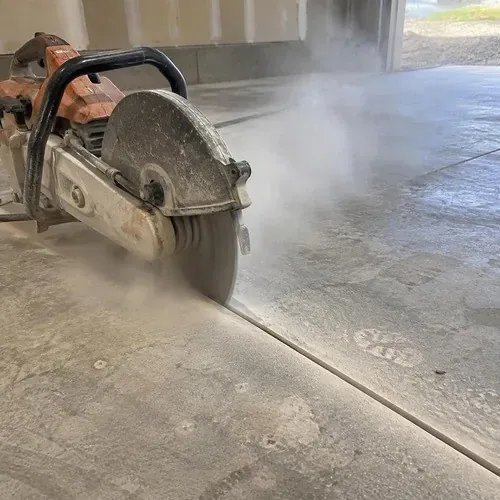
Most slab cracks fall into three groups, each with a different cause and fix.
Concrete shrinks as it cures and dries. Hairline cracks appear, often in random patterns or from corners, within the first months.
They are cosmetic in almost all cases. Once the slab is fully cured, they usually stop moving.
Settlement cracks come from soil movement under the slab. They tend to be wider, uneven, and often one side sits higher than the other.
If a crack keeps widening or shows vertical displacement, we recommend a structural engineer's review before any flooring repair.
In Waterloo Region, road salt tracked into garages on tires is the usual culprit. Salty meltwater soaks into the surface, freezes and pops off flakes of concrete.
Older garage slabs poured without air entrainment are most at risk. The damage looks like peeling or pitting across the surface.
We match the repair to the crack and to what will go on top.
For dormant cracks that need a structural bond, we inject low-viscosity epoxy under low pressure through surface ports. The epoxy fills the crack through its depth and bonds the two sides.
The repaired section is often stronger than the concrete around it.
Moving cracks and control joints need a filler that flexes. Semi-rigid polyurea cures in minutes, supports forklift and car tires, and still allows a little movement.
It is our standard filler before an epoxy flooring installation in garages and plants.
Scaled and spalled surfaces are ground to sound concrete, then rebuilt with a polymer-modified patch or a thin resurfacing overlay. The result is a new wear surface bonded to the old slab.
Badly broken slabs may be better replaced. Our concrete floor installation page covers that option.
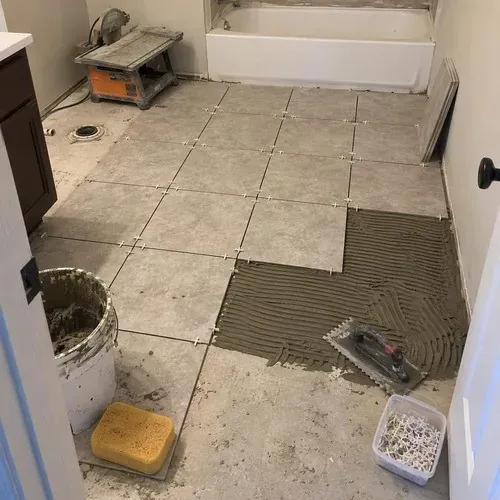
Tile damage can usually be fixed without replacing the whole floor.
We cut out the grout around a cracked tile, break it out carefully so neighbours are not disturbed, and scrape the old mortar flat. The new tile is set, levelled and grouted to match.
For discontinued tile, we check your spare boxes first, then borrow from hidden areas like under appliances, or use a deliberate accent tile where matching is impossible.
Small chips on edges and corners can be filled with a tinted epoxy or polyester filler, shaped and polished. On plain, matte tiles the repair is very hard to spot.
Glossy and patterned tiles are harder to match, and replacement often looks better.
Cracked grout along a line often means movement below, not bad grout. A missing perimeter movement joint is another common cause, especially in sunny rooms and large floors.
We fix the movement issue, then regrout. Tired but sound grout is handled through our tile and grout restoration service.
When several tiles crack in a straight line, the cause is almost never the tile. The line is tracing something underneath.
It might be a shrinkage crack in the slab, a seam between plywood sheets or the edge of a joist. As that line moves, it breaks the tile above it.
The permanent fix is to replace the tiles over an uncoupling or crack isolation membrane that absorbs the movement. Our tile flooring installation page explains how those membranes work.
Typical 2026 ranges in Kitchener and Waterloo:
| Repair | Typical cost |
|---|---|
| Epoxy injection, structural cracks | $15 to $30 per linear foot |
| Polyurea crack or joint filling | $4 to $8 per linear foot |
| Resurfacing a scaled garage slab | $4 to $8 per sq ft |
| Cracked tile replacement, first tile | $175 to $325 |
| Tile chip fill and colour match | $75 to $150 per chip |
Small repairs carry a minimum visit charge, which we tell you upfront. All crack and chip repairs include our 1-year labour warranty.
Keep exploring
Where this service is in highest demand:
FAQ
Straight answers to the questions we hear most. Still unsure? Call and ask.
Ask for a Free QuoteIf the crack is dormant, a rigid epoxy repair will hold. If it is still moving, a rigid repair will crack again beside it, so we use a flexible filler instead. Diagnosing movement first is how we make a repair last.
Almost always because something underneath is moving, such as a slab crack, a plywood seam or a joist. The tile is not the problem. The fix is to replace the tiles over an uncoupling or crack isolation membrane.
Small chips on edges and corners can be filled with a tinted epoxy and polished to blend. Chips in the middle of a patterned or glossy tile are harder to hide, and replacement often looks better.
Usually not. Most basement slab cracks are shrinkage cracks and are cosmetic. Cracks that are wider than about 1/4 inch, have one side higher than the other or keep growing may point to settlement and should be looked at by an engineer.
Free estimate
Tell us about the floor. We will call to book a time, measure on site, check the subfloor and moisture, and leave you a written quote.
Prefer to talk it through first? Call and speak to a flooring specialist directly.
Kitchener Prestige Flooring
137 Glasgow St, Kitchener, ON N2M 5E3
Monday to Saturday: 7:00am to 9:30pm
Sunday: 9:00am to 9:00pm