Skip to content
Kitchener Prestige Flooring

Wood flooring

Hardwood Floor Installation in Kitchener, Ontario

Kitchener Prestige Flooring installs solid hardwood floors for homeowners, builders and property managers across Kitchener and Waterloo Region. Our crew has spent more than 16 years and over 1,700 jobs learning how local homes behave, from 1920s plank subfloors near Victoria Park to engineered joists in Doon South.

We handle the whole job in house. That means removing the old floor, checking the subfloor, testing moisture, nailing the new boards down and fitting the trim, stair nosings and transitions.

Every hardwood installation is licensed, insured, WSIB covered and backed by a written 1-year labour warranty. You get a firm, itemized quote after a free in-home measure, not a guess over the phone.

  • Licensed & insured
  • WSIB covered
  • 1-year labour warranty
  • Free in-home estimates
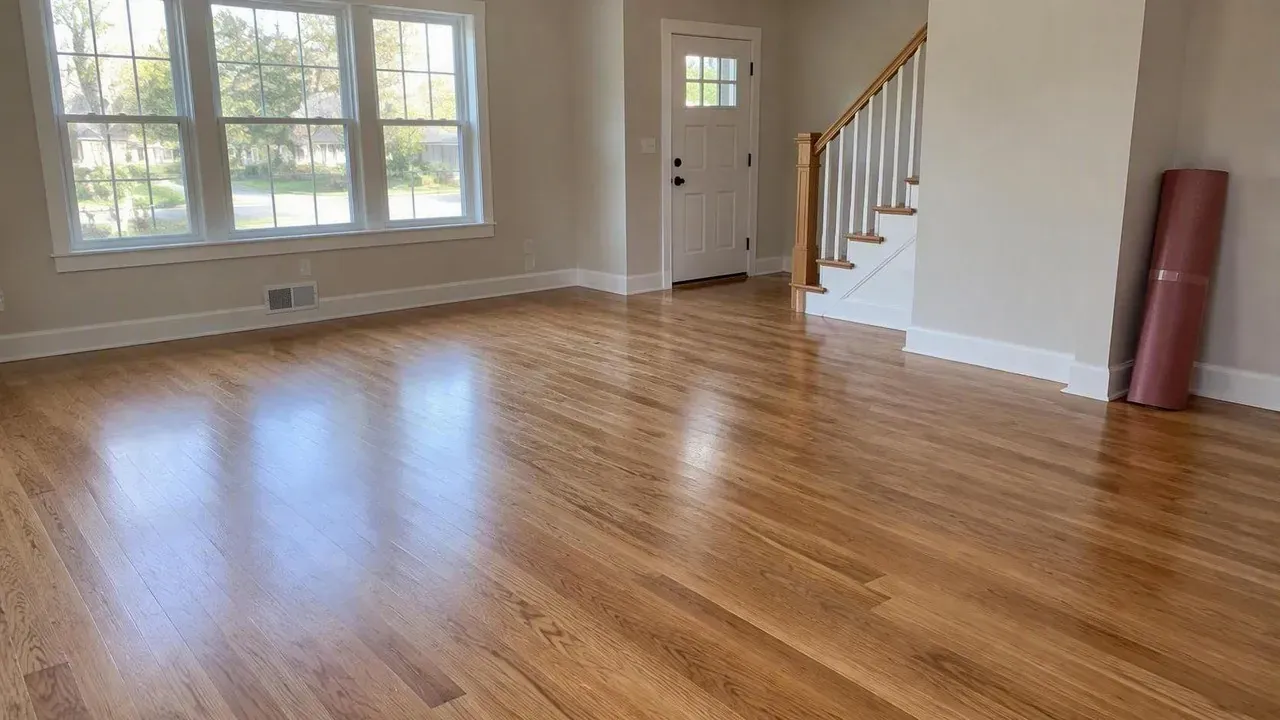
Newly installed solid oak hardwood floor in a bright Kitchener living room

Solid Hardwood and Where It Belongs

Solid hardwood is one piece of timber, usually 3/4 inch thick, milled with a tongue and groove. It can be sanded and refinished five or six times, which is why a well-installed oak floor outlives most of the houses we work in.

It has one firm rule. Solid hardwood goes on or above grade, over a wood subfloor, in rooms where the humidity is controlled.

That means main floors and upper levels. It does not mean basements, slab-on-grade additions or bathrooms. For those spaces we steer you to engineered hardwood or luxury vinyl plank, which handle moisture and concrete far better.

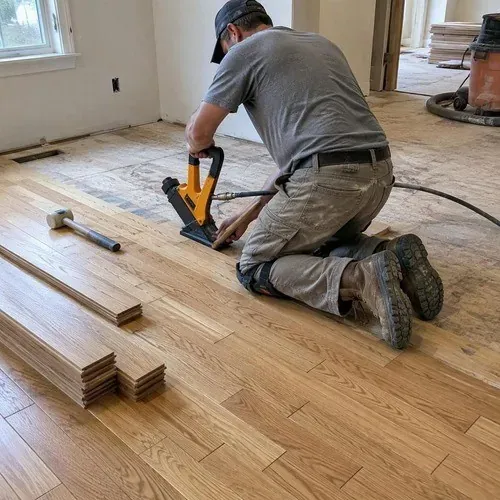
Installer blind-nailing solid oak hardwood strips over a plywood subfloor

Species We Install and How They Differ

Species decides how hard the floor is, how the grain reads and how it takes stain. Hardness is measured on the Janka scale, the force needed to press a steel ball into the wood.

Red Oak, White Oak and Maple

Red oak (Janka 1290) is the classic Kitchener floor. Its open grain takes stain evenly and hides wear, and it matches most original floors in pre-war homes.

White oak (1360) has tighter grain and a cooler tone. It suits natural, grey and fumed finishes and is the first choice for wide plank.

Hard maple (1450) is dense and bright but blotches under dark stain. We water-pop or use a conditioner when a customer wants maple darker than natural.
Ash, Hickory and Birch

Hickory (1820) is one of the hardest domestic species and shrugs off dogs and kids. Its dramatic colour variation is a love-it-or-leave-it look.

Ash (1320) has bold grain similar to oak with a lighter colour. Yellow birch (1260) is softer, with a warm, subtle figure that suits cottage and farmhouse interiors.

These species are less common locally, so lead times can run two to three weeks. We confirm stock before you commit.

Board Width, Grade and Finish Choices

Three decisions shape the look and the long-term behaviour of your floor. Here is what each one actually changes.

Strip, Plank and Wide Plank

Strip flooring runs 2-1/4 inches wide. Plank starts at 3 inches, and wide plank is anything over 5.

Wider boards move more with the seasons. Ontario homes swing from about 60% humidity in August to 25% in February, so wide solid planks need tighter humidity control or an engineered construction.

Select, Character and Rustic Grades

Select and Better is clean, with few knots and uniform colour. Number 1 Common, often sold as character grade, shows knots and mineral streaks.

Rustic or Number 2 Common has the most variation and the lowest price. It also has shorter boards, so budget a little more waste.

Site-Finished Versus Prefinished

Prefinished boards arrive with a factory finish. You can walk on them the same day, but they have small bevelled edges that collect dirt.

Site-finished floors are installed raw, sanded flat, stained and coated in place. There are no bevels, you can match an existing floor exactly, and the finish is one seamless film. Expect three to five extra days for sanding, coats and cure.

Nail-Down Installation Over Wood Subfloors

Solid hardwood is fastened mechanically. We use a pneumatic flooring nailer to drive 2 inch cleats or 15.5 gauge staples through the tongue at 45 degrees, so no fasteners show.

Fasteners go every 8 to 10 inches along each board and within 2 to 3 inches of each end. Boards run perpendicular to the floor joists wherever the room allows, which stiffens the floor.

The first row sets the whole job. We snap a chalk line off the longest straight wall, face-nail that row and check it for square before any blind nailing starts.

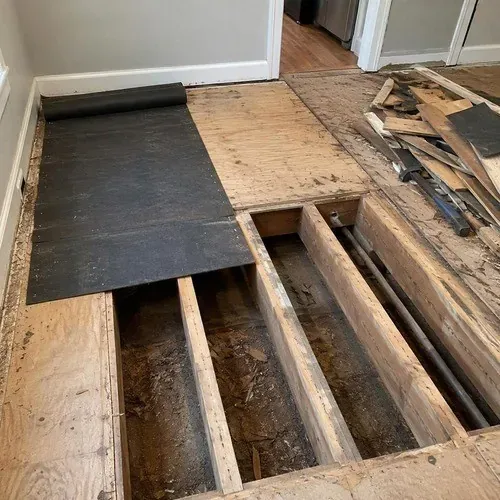
We lay rosin paper or an approved underlayment first to reduce squeaks and dust. Plank subfloors in older Kitchener homes get extra screws into the joists before the new floor goes down.

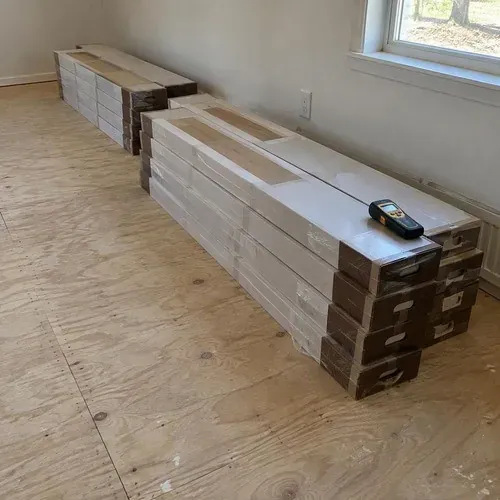
Hardwood flooring cartons acclimating with a moisture meter checking the boards

Acclimation and Moisture Control Before We Start

Most hardwood failures we are called to fix started with moisture. Cupped boards, crowned centres and gaps in the first winter all trace back to skipped testing.

We deliver the flooring, open the cartons and let it sit in the rooms where it will be installed, with the heat or air conditioning running. Typical acclimation is three to seven days.

We do not install on a schedule. We install on readings.

  • Subfloor moisture: 12% or lower, checked with a pin meter at several points in each room.
  • Strip flooring: within 4% of the subfloor reading.
  • Planks over 3 inches: within 2% of the subfloor reading.
  • Room conditions: 15 to 27 degrees Celsius and 35% to 55% relative humidity.

Expansion Gaps, Transitions and Door Casings

Wood needs room to move. We leave a 3/4 inch gap at every wall, column and fixed cabinet, hidden under the baseboard or shoe moulding.

Door casings are undercut with a jamb saw so the boards slide underneath. That gives a clean edge with no caulk line.

Where hardwood meets tile, carpet or vinyl, we fit a matching T-moulding, reducer or threshold. At stairs we install flush or overlap nosings so the first tread lines up with the floor. See our stairs, treads and railings service if the staircase is part of the plan.

Subfloor prepared with rosin paper before a nail-down hardwood floor installation

What Hardwood Installation Costs Around Waterloo Region

Every floor is quoted on site, but these are the ranges we see most often in Kitchener, Waterloo and Cambridge in 2026.

Item Typical cost per sq ft
Nail-down installation labour, prefinished solid $4.00 to $7.00
Sand, stain and finish for site-finished floors $3.50 to $5.50
Solid hardwood material, select to character grade $6.00 to $14.00
Remove and dispose of existing flooring $1.00 to $2.50

Price moves with the room, not just the square footage. Stairs, herringbone or diagonal layouts, many doorways, levelling and subfloor repairs all add time. Your written quote lists each of these as its own line.

Our Hardwood Labour Warranty

Every hardwood floor we install carries a written 1-year labour warranty. If a board works loose, a fastener fails or the floor squeaks because of how we installed it, we come back and fix it at no charge.

The warranty does not cover damage from floods, leaks or a home kept outside the 35% to 55% humidity range. Your flooring manufacturer's material warranty is separate and often runs 25 years or more.

We install to the manufacturer's written instructions, which keeps that material warranty valid. We also give you care notes and a humidity guide when the job is done.

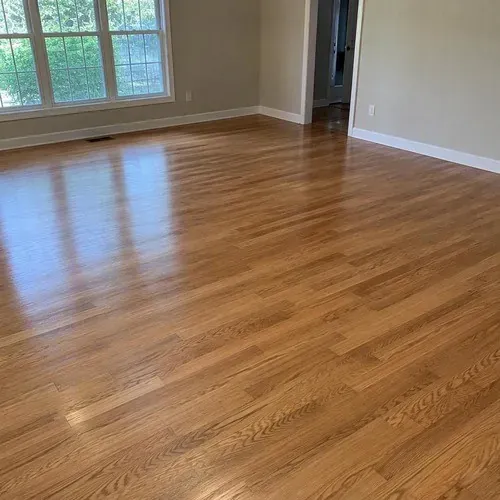
Site-finished oak hardwood floor with a satin finish in a Kitchener home

FAQ

Hardwood Installation Questions

Straight answers to the questions we hear most. Still unsure? Call and ask.

Ask for a Free Quote

How long does hardwood need to acclimate in an Ontario home?

Most solid hardwood needs three to seven days, but we go by meter readings rather than the calendar. The boards are ready when they sit within 4% of the subfloor for strip flooring, or within 2% for planks wider than 3 inches. In January, when furnaces run hard, that can take longer.

Can solid hardwood be installed in a basement?

No. Concrete slabs below grade release moisture all year, and solid boards will cup or buckle. For basements we recommend engineered hardwood glued or floated over a proper moisture barrier, or luxury vinyl plank.

Will my floor gap in winter?

Some seasonal gapping is normal in Ontario. Indoor humidity can fall to 25% in February, and the boards shrink. Keeping your home between 35% and 55% relative humidity with a furnace humidifier keeps gaps to a hairline, and they close again in spring.

Can you install hardwood over an existing floor?

Sometimes. We can nail over a single layer of sound, flat, well-fastened hardwood or plywood.

We will not install over carpet, cushioned vinyl or ceramic tile. Those layers compress, crack or stop the fasteners from holding, so they come out first.

Free estimate

Book a Free Hardwood Floor Installation Estimate

Tell us about the floor. We will call to book a time, measure on site, check the subfloor and moisture, and leave you a written quote.

Prefer to talk it through first? Call and speak to a flooring specialist directly.

  • Measured on site, with moisture and flatness readings
  • Written, itemized quote with no obligation
  • Licensed, insured, WSIB covered, 1-year labour warranty

Kitchener Prestige Flooring

137 Glasgow St, Kitchener, ON N2M 5E3

info@kitchenerflooring.ca

Monday to Saturday: 7:00am to 9:30pm

Sunday: 9:00am to 9:00pm

Call (548) 490-1518 Quote