Skip to content
Kitchener Prestige Flooring

Tile & stone

Tile Flooring Installation in Kitchener, Ontario

A tile floor lasts decades when the layers underneath are right, and cracks in months when they are not. Kitchener Prestige Flooring installs floor tile for homeowners, renovators, builders and businesses in Kitchener, Waterloo, Cambridge and nearby towns.

We have spent over 16 years and 1,700 jobs learning what goes wrong under tile. Bouncy joists, cracked slabs and skipped membranes cause most failures, so that is where our installation starts.

Our tile setters are licensed, insured and WSIB covered. Every tile floor is backed by a written 1-year labour warranty, and estimates are free and in person.
  • Licensed & insured
  • WSIB covered
  • 1-year labour warranty
  • Free in-home estimates
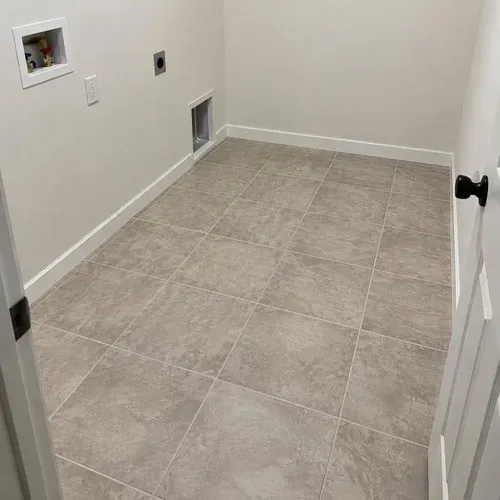
Finished square tile floor installed in a Kitchener laundry room

Tile Work We Take On Across Waterloo Region

This page covers how we install tile and what goes under it. For help choosing the tile itself, see the material pages linked further down.

Bathroom and Shower Floors

Bathroom floors need waterproofing, the right slope to drains and a slip-resistant tile. We install everything from small hex mosaics to large format porcelain.

Curbless shower floors are a speciality. They need careful slope planning and a fully bonded waterproof membrane.

Kitchens, Entryways and Mudrooms

Kitchens need a floor that shrugs off dropped pots and spills. Entryways in Kitchener deal with road salt, meltwater and grit every winter.

We choose tile, grout and sealers for that abuse, and set them over a flat, stiff substrate so nothing cracks.

Commercial Washrooms and Entrances

Restaurants, offices and retail spaces need tile that meets slip resistance targets and cleans easily. We work after hours so businesses stay open.

Commercial clients get WSIB clearance and insurance certificates on request.

Membranes, Waterproofing and Crack Isolation

What goes under the tile decides how long it lasts. These are the systems we install most often.

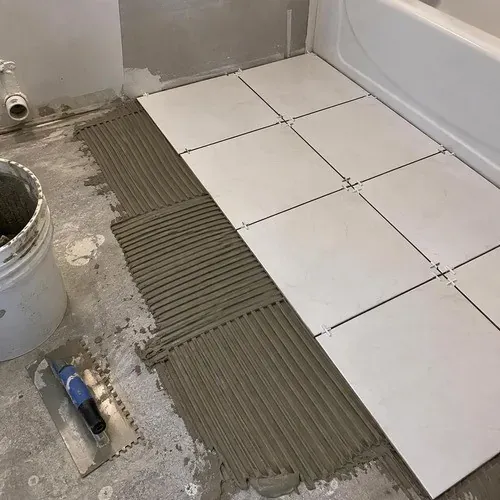
Thinset mortar combed with a notched trowel as the first floor tiles are set

Uncoupling Membranes Over Concrete and Plywood

An uncoupling membrane such as Schluter DITRA sits between the substrate and the tile. Its waffle structure lets the floor below move slightly without cracking the tile above.

We use it over basement slabs with shrinkage cracks, over plywood subfloors and under large format tile. DITRA-HEAT combines uncoupling with in-floor heating cable.

Waterproofing in Wet Areas

In showers, steam rooms and wet areas, we install bonded waterproofing such as Schluter KERDI sheet membrane or liquid-applied membranes like Laticrete Hydro Ban and Mapei AquaDefense.

Seams, corners and drains are sealed with matching preformed pieces. We flood test shower floors for 24 hours before tile goes down.

Substrate Preparation and Deflection Limits

Tile needs a floor that barely flexes. Industry standards call for a deflection limit of L/360 for ceramic and porcelain, and L/720 for natural stone.

In plain terms, a floor spanning 12 feet can only sag about 0.4 inch under load for ceramic. Many older Kitchener homes with 2x8 joists fail that test without reinforcement.

We check joist size, span and spacing, then add blocking, sister joists or a second layer of plywood where needed. Mortar coverage is checked by pulling tiles: at least 80% in dry rooms and 95% in wet areas.

Layout, Grout Lines and Lippage Control

Layout starts from the centre of the room and the main sightline. Cut tiles at doorways and walls are kept to at least half a tile wherever possible.

Grout joint width depends on the tile. Rectified porcelain can go as tight as 1/16 inch, standard ceramic usually needs 1/8 inch, and handmade or tumbled tiles need 3/16 inch or more.

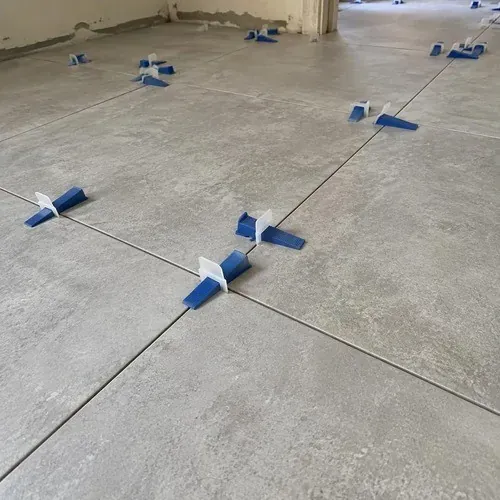
Lippage is the height difference between neighbouring tiles. We use levelling clips on larger tiles to keep edges flush, well within the 1/32 inch industry allowance for tight joints.

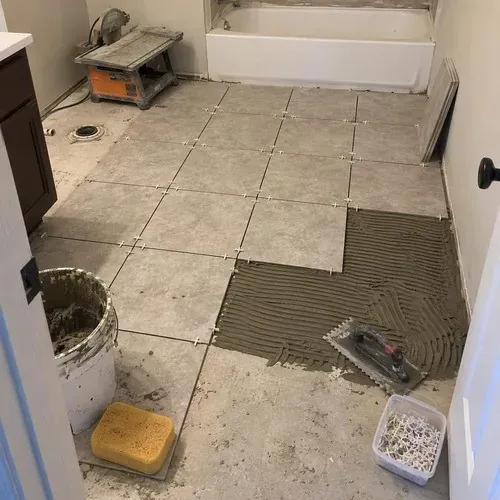
Tile floor half installed with spacers, sponge and bucket

Large Format Tile and Why It Is Harder

Tiles with any side 15 inches or longer count as large format. They look clean and modern but demand more from the installer.

The substrate must be flatter, about 1/8 inch over 10 feet. Tiles need a medium-bed mortar, back-buttering and levelling clips, and they are heavy to handle.

Long rectangular tiles also bow slightly in manufacturing. We limit the offset to one third of the tile length to avoid lipped edges. A flat floor starts with good floor levelling and patching.

Choosing a Material for Your Tile Floor

Each material has its own strengths, and each has a dedicated page:

Want tile that is warm in winter? Pair it with radiant heated flooring, installed in the same project.

Leveling clips controlling lippage between large-format floor tiles

Tile Installation Pricing in Kitchener

Typical 2026 labour ranges in Waterloo Region, before tile:

Item Typical cost per sq ft
Standard ceramic or porcelain, 12 to 24 inch $6.00 to $11.00
Large format porcelain, 24 by 48 and up $9.00 to $15.00
Mosaic and small format $12.00 to $20.00
Uncoupling membrane, supplied and installed $2.50 to $4.50
Tile removal and disposal $2.00 to $4.00

Heated floors, joist reinforcement and shower waterproofing are quoted separately. Every tile floor includes our 1-year labour warranty.

FAQ

Tile Installation Questions

Straight answers to the questions we hear most. Still unsure? Call and ask.

Ask for a Free Quote

Do I need an uncoupling membrane under my tile?

Over a basement slab with cracks, or a wood subfloor, we strongly recommend one. The membrane lets the substrate move slightly without transferring that movement into the tile. It costs a few dollars per square foot and prevents most cracked-tile callbacks.

Can tile be installed over a plywood subfloor?

Yes, if the floor is stiff enough. We check joist size and spacing, add a second layer of plywood or an uncoupling membrane where needed, and never set tile directly on a single layer of OSB.

How long before I can walk on a new tile floor?

With standard thinset, you can walk carefully on the floor after about 24 hours. Grout needs another day before light traffic. Rapid-setting mortars can shorten that to a few hours when a room has to be back in use quickly.

Why does tile crack over a basement slab?

Concrete shrinks and moves as it cures and as seasons change. Existing slab cracks often keep moving, and tile set directly over them cracks along the same line. An uncoupling or crack-isolation membrane stops that.

Free estimate

Book a Free Tile Flooring Installation Estimate

Tell us about the floor. We will call to book a time, measure on site, check the subfloor and moisture, and leave you a written quote.

Prefer to talk it through first? Call and speak to a flooring specialist directly.

  • Measured on site, with moisture and flatness readings
  • Written, itemized quote with no obligation
  • Licensed, insured, WSIB covered, 1-year labour warranty

Kitchener Prestige Flooring

137 Glasgow St, Kitchener, ON N2M 5E3

info@kitchenerflooring.ca

Monday to Saturday: 7:00am to 9:30pm

Sunday: 9:00am to 9:00pm

Call (548) 490-1518 Quote