Skip to content
Kitchener Prestige Flooring

Concrete & epoxy

Concrete Polishing in Kitchener, Ontario

Polished concrete turns the slab you already have into a finished floor. Kitchener Prestige Flooring grinds, densifies and polishes concrete for warehouses, retail showrooms, offices and modern homes across Kitchener and Waterloo Region.

Our crew has more than 16 years of experience and 1,700+ flooring jobs completed. We use dust-extracted planetary grinders and stage every job through the full grit sequence, so the gloss is in the concrete, not in a coating.

We are licensed, insured and WSIB covered. Every polished floor comes with a written 1-year labour warranty and a clear maintenance plan.

  • Licensed & insured
  • WSIB covered
  • 1-year labour warranty
  • Free in-home estimates
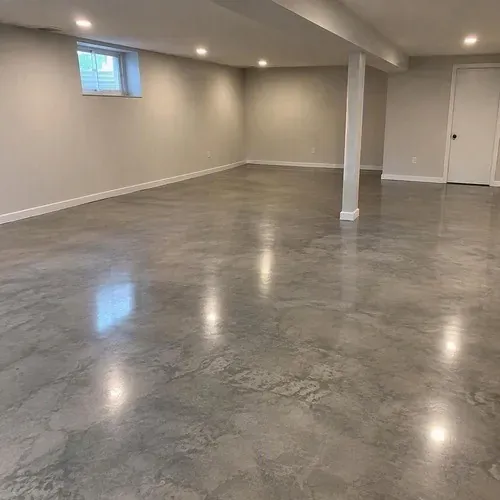
Polished grey concrete floor in a finished basement

Polished Concrete Is Not a Coating

This is the whole argument for polished concrete. Nothing is applied on top to wear off, peel or delaminate.

The shine comes from grinding the concrete itself with finer and finer diamonds, like polishing stone. A chemical densifier hardens the surface from within.

Epoxy and other coatings have their place and their own page. See epoxy flooring installation if you need colour, chemical resistance or a seamless wash-down floor.

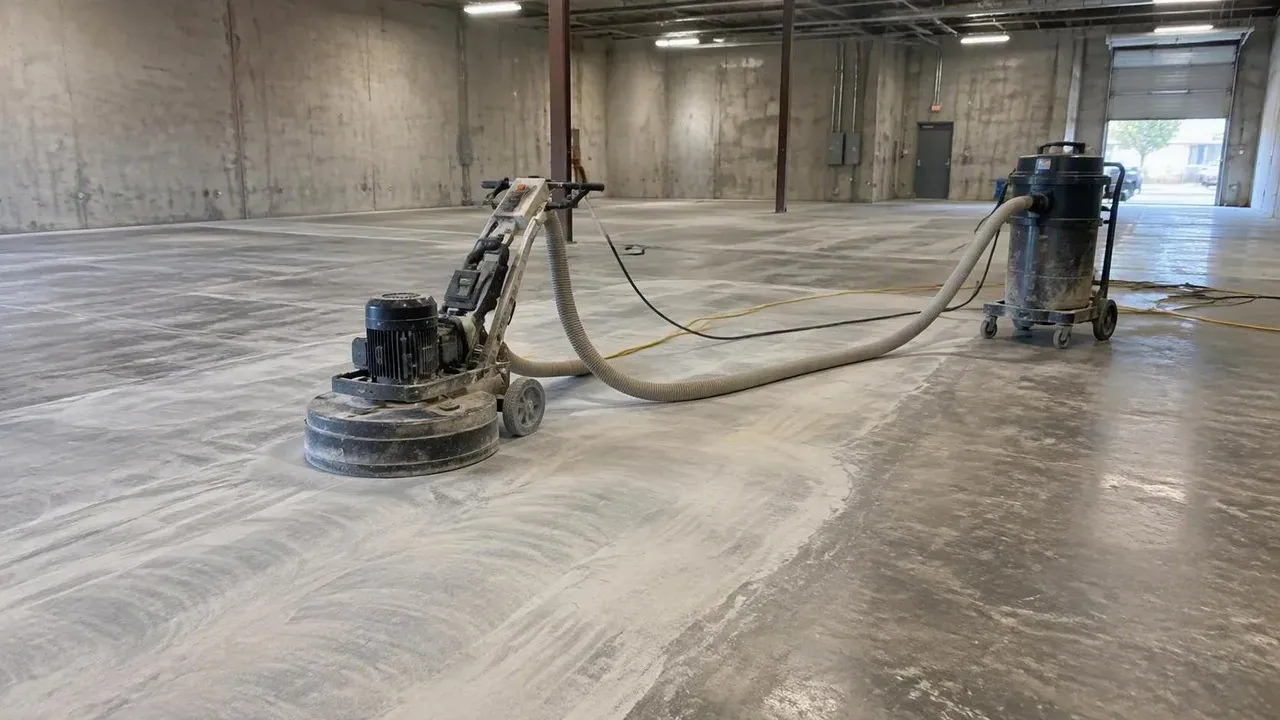
Planetary grinder with dust extraction polishing a concrete floor

Grit Levels and Gloss Explained

Polished concrete is described by how far the grinding goes. More grit stages means more shine.

Grind and Seal Versus True Mechanical Polish

Grind and seal grinds the surface lightly, then applies a topical sealer for shine. It is cheaper, but the sealer wears and needs reapplying.

True mechanical polish progresses from metal-bonded diamonds to resin-bonded diamonds, often up to 800, 1500 or 3000 grit. The gloss is in the concrete and lasts.
Gloss Readings and What Each Level Looks Like

  • Flat or honed, around 100 to 200 grit: matte, no reflection. Suits industrial floors.
  • Satin, around 400 grit: low sheen, soft reflection. Popular for basements.
  • Semi-polished, around 800 grit: clear reflection of lights. Common in retail.
  • Highly polished, 1500 to 3000 grit: mirror-like, sharp reflections. Showrooms and lobbies.

We measure the result with a gloss meter and record the reading.

Aggregate Exposure Levels

How deep we grind decides how much stone shows in the floor. This is a visual choice you make before we start.

  • Cream finish: barely any aggregate, a smooth and even grey.
  • Salt and pepper: fine sand and small stones scattered across the surface.
  • Full aggregate: larger stones exposed for a terrazzo-like look.

Exposure depends on the slab. We test grind a small area so you can see the actual result.

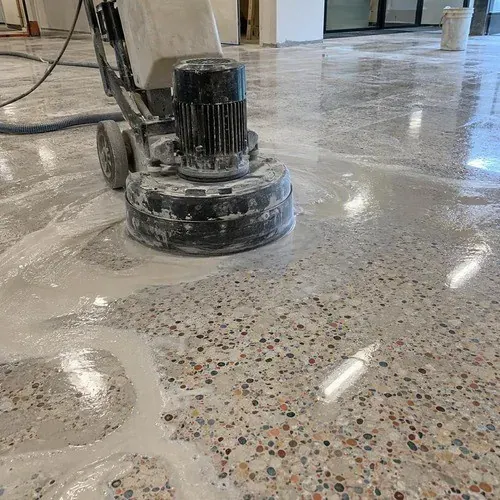
Floor grinder refining a concrete surface through finer diamond grits

Densifiers and How Polished Concrete Hardens

A densifier, usually lithium or sodium silicate, is applied partway through grinding. It reacts with free lime in the concrete to form a harder compound in the surface pores.

That makes the surface harder, more dust resistant and able to take a higher polish. It is a big reason polished floors stop shedding concrete dust.

A penetrating stain guard is added at the end to resist oil and spills.

Slip Resistance on a Polished Floor

The most common worry is slipperiness. A shiny floor looks slippery, but gloss and grip are not the same thing.

A properly polished and maintained floor usually tests at or above the 0.42 wet DCOF benchmark used for level interior floors. Contaminants like dust, water and oil are what make floors slippery.

For entrances and wet areas, we recommend walk-off mats and can apply slip-resistant treatments where needed.

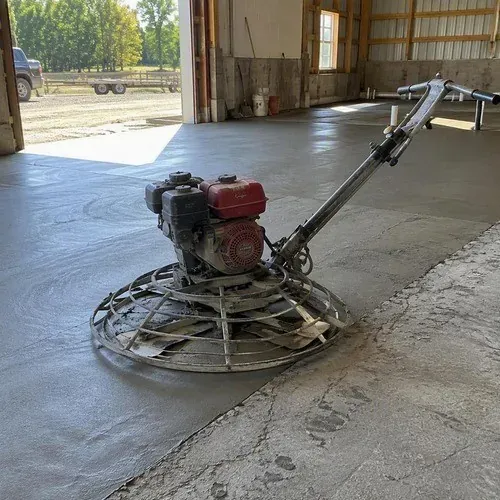
Power-trowelled concrete slab that will be ground and polished

Where Polished Concrete Works Best

Polished concrete suits spaces that want durability, low maintenance and a clean, modern look.

Warehouses and Distribution Floors

No coating to wear off under forklift traffic, less dust and brighter aisles from reflected light. Our industrial flooring team combines it with joint repair and line striping.

Retail and Showroom Spaces

Showrooms, galleries and shops use polished concrete for its look and easy cleaning. High gloss reflects lighting and makes spaces feel larger.

Residential Basements and Modern Builds

In basements, polishing turns the existing slab into a finished floor with no risk of moisture lifting a coating. It pairs well with area rugs and in-floor heating.

Existing Slab Condition and What Can Be Polished

Every slab polishes differently. Patches, cracks and old repairs will show, because polishing reveals the concrete as it is.

Old coatings, paint and adhesives must be removed first. Very soft or poorly finished slabs may not reach a high gloss.

For new construction, we coordinate the pour so the slab is finished for polishing. See concrete floor installation.

Maintenance, and Why Waxing Ruins It

Dust mop daily and clean with a pH-neutral cleaner, using an auto-scrubber in larger spaces. Periodic burnishing with a fine diamond pad keeps the shine up.

Never wax polished concrete. Wax sits on top, turns slippery, yellows and hides the polish you paid for. Stripping it later costs money.

Concrete Polishing Costs

Typical 2026 ranges in Waterloo Region:

Finish Typical cost per sq ft
Grind and seal $3.00 to $6.00
Mechanical polish, satin to semi-polished $4.00 to $8.00
High gloss polish $6.00 to $10.00
Full aggregate exposure add $1.00 to $3.00
Coating or adhesive removal $1.50 to $4.00

Larger floors cost less per square foot. All polishing work carries our 1-year labour warranty. Ongoing care for commercial floors is covered on our floor buffing and waxing page.

FAQ

Concrete Polishing Questions

Straight answers to the questions we hear most. Still unsure? Call and ask.

Ask for a Free Quote

Is polished concrete slippery when wet?

A properly polished and maintained floor is usually no more slippery than sealed concrete or VCT, and many test above the 0.42 DCOF benchmark. Water, dust and oil make any floor slippery, so walk-off mats and regular cleaning matter.

Can any concrete slab be polished?

Most sound slabs can. Very soft, heavily patched or badly cracked slabs polish unevenly, and repairs will show.

Old coatings and adhesives must be removed first. We test grind a small area to show you what to expect.

Polished concrete or epoxy, which lasts longer?

Polished concrete usually lasts longer because there is no coating to wear through or peel. Epoxy is better where heavy chemical spills, colour or seamless wash-down are needed.

Does polished concrete need sealing?

It is densified, then usually protected with a penetrating guard that resists stains. It does not need a topical coating, and it should never be waxed.

Free estimate

Book a Free Concrete Polishing Estimate

Tell us about the floor. We will call to book a time, measure on site, check the subfloor and moisture, and leave you a written quote.

Prefer to talk it through first? Call and speak to a flooring specialist directly.

  • Measured on site, with moisture and flatness readings
  • Written, itemized quote with no obligation
  • Licensed, insured, WSIB covered, 1-year labour warranty

Kitchener Prestige Flooring

137 Glasgow St, Kitchener, ON N2M 5E3

info@kitchenerflooring.ca

Monday to Saturday: 7:00am to 9:30pm

Sunday: 9:00am to 9:00pm

Call (548) 490-1518 Quote