Skip to content
Kitchener Prestige Flooring

Concrete & epoxy

Epoxy Floor Recoating in Kitchener, Ontario

Recoating a failing epoxy floor without knowing why it failed just buys you a year. Kitchener Prestige Flooring assesses, repairs and recoats worn, peeling and yellowed epoxy floors for homeowners, businesses and industrial sites across Kitchener and Waterloo Region.

With more than 16 years and 1,700+ flooring jobs, we have seen every way a coating can fail. Diagnosis is the service: we test adhesion and moisture before we quote, so you pay for a fix that lasts.

Our crew is licensed, insured and WSIB covered. Every recoat is backed by a written 1-year labour warranty.
  • Licensed & insured
  • WSIB covered
  • 1-year labour warranty
  • Free in-home estimates
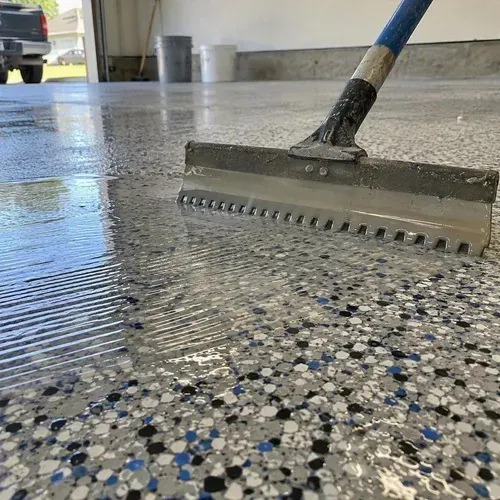
Clear topcoat applied during an epoxy floor recoat

When an Epoxy Floor Needs Recoating Rather Than Replacing

New installations live on our epoxy flooring installation page. This page is for existing floors that are worn, damaged or starting to fail.

Recoating makes sense when the original coating is still well bonded to the concrete. The wear is on the surface, and a fresh topcoat restores protection and appearance.

Replacement makes sense when the coating is lifting, blistering or failing adhesion tests. Recoating over a failure just seals the problem in.

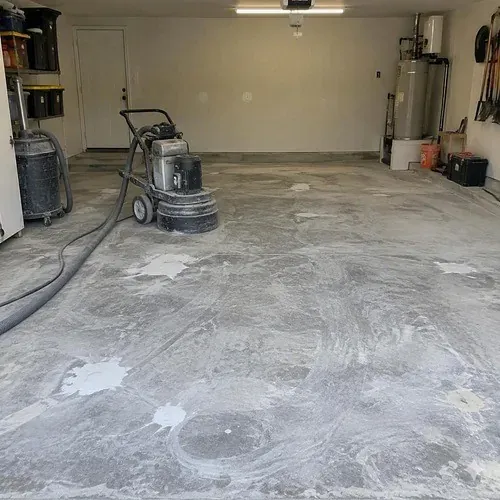
Worn epoxy floor diamond ground to profile before recoating

Diagnosing Why the Existing Coating Failed

Diagnosis is the real service here. Each failure has a different cause and a different fix.

Adhesion Failure From Poor Preparation

Coatings that peel in sheets, especially where tires sit, were usually applied over concrete that was only cleaned or acid etched. Without a mechanical profile, the coating never gripped.

The fix is full removal and proper diamond grinding.

Moisture Vapour Pushing the Coating Off

Blisters, bubbles and peeling with a white or damp residue underneath point to moisture from the slab. It is common in basements and slabs without a vapour barrier.

We test the slab, and the new system includes a moisture mitigation primer.

UV Yellowing and Chalking

Epoxy yellows in sunlight, and some coatings chalk and fade near garage doors and windows. The coating may be sound but looks tired.

A UV-stable polyaspartic or polyurethane topcoat fixes the look and stops it happening again.

Normal Abrasion and Traffic Wear

Worn traffic lanes, scratches and dulling in a well-bonded floor are simple wear. This is the ideal case for a recoat.

Adhesion Testing Before We Quote

We test before we quote, not after. A simple cross-hatch tape test shows whether the coating is holding to the slab.

For commercial and industrial floors, we can do pull-off tests that measure bond strength. We also check moisture in areas showing blisters.

The results decide whether we recoat, repair sections or remove the coating entirely.

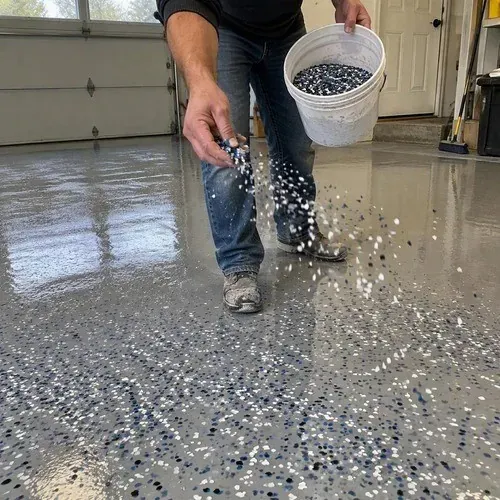
Vinyl flakes broadcast to blend a repaired area of an epoxy floor

Preparing an Existing Coated Floor

A new coat bonds to a prepared surface, not to a dirty or glossy one.

Diamond Grinding to Profile

For sound coatings, we grind the surface with diamond tooling to remove gloss, contaminants and loose material. That gives the new coat a mechanical grip.

Oil, tire marks and silicone are removed first, because they stop any coating from bonding.

Full Removal When Partial Will Not Do

When large areas are failing, we grind or shot blast the old coating off completely, back to sound concrete. Cracks and joints are repaired before the new system goes down.

It costs more than a recoat, but it is the only way to end the cycle of peeling.

Compatibility Between Old and New Systems

Not every coating bonds to every other coating. Polyaspartic and polyurethane topcoats generally bond well to properly abraded epoxy.

Epoxy over old polyurethane, acrylic sealers or waxed floors can fail unless the old layer is fully profiled or removed. Some older coatings are hard to identify.

When we are unsure, we apply a test patch and check its adhesion before committing to the full floor.

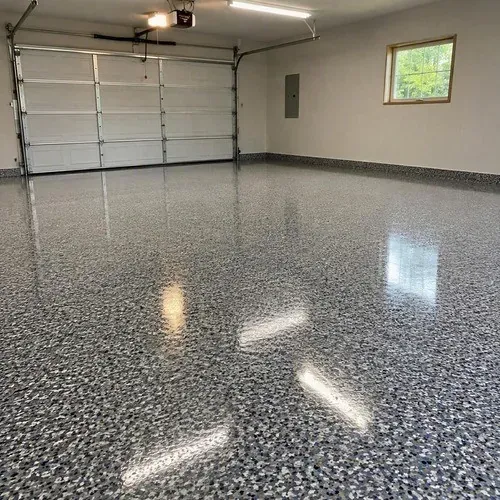
Recoated flake epoxy garage floor in Kitchener

Spot Repairs, Patching and Colour Matching

Damaged areas, such as gouges from dropped tools or peeling at a garage door, can often be repaired in place. We grind out the area, rebuild it and blend it into the surrounding floor.

Flake floors hide patches well. Solid colours are harder to match exactly, so we end repairs at joints or natural edges where a slight difference will not show.

Recoat Intervals by Environment

These intervals help you plan and budget for maintenance.

Environment Typical topcoat recoat interval
Residential garage 8 to 12 years
Retail and showroom 5 to 8 years
Commercial kitchen 3 to 5 years
Warehouse aisles and forklift lanes 2 to 4 years
Manufacturing floors 2 to 5 years, by traffic

Commercial and industrial clients can book recoats on a schedule. See our industrial flooring and commercial flooring pages for full maintenance programs.

Recoating Costs Versus Full Replacement

Typical 2026 ranges in Waterloo Region:

Service Typical cost per sq ft
Scuff and topcoat refresh $2.00 to $4.00
Grind, repair and recoat $4.00 to $7.00
Remove old coating and new system $7.00 to $12.00

If you are tired of coatings altogether, concrete polishing removes the coating and polishes the slab itself. All recoating work carries our 1-year labour warranty.

FAQ

Epoxy Recoating Questions

Straight answers to the questions we hear most. Still unsure? Call and ask.

Ask for a Free Quote

Can you recoat over an existing epoxy floor?

Yes, if the existing coating is still well bonded. We scuff or grind it to profile, clean it and apply a compatible coat. If it is peeling or failing adhesion tests, it has to come off first.

Why did my epoxy floor peel?

The usual causes are poor surface preparation, such as acid etching instead of grinding, moisture pushing up from the slab, or a thin, low-quality coating that could not handle hot tires or traffic.

How often should an epoxy floor be recoated?

Home garages usually need a fresh topcoat every 8 to 12 years. Busy commercial kitchens and warehouse aisles may need it every 2 to 5 years. We set a schedule based on your traffic.

Can you patch just the worn area?

Often, yes. We grind out the damaged area, rebuild it and blend it into the surrounding floor, usually ending the patch at a joint or edge. Flake floors blend better than solid colours.

Free estimate

Book a Free Epoxy Floor Recoating Estimate

Tell us about the floor. We will call to book a time, measure on site, check the subfloor and moisture, and leave you a written quote.

Prefer to talk it through first? Call and speak to a flooring specialist directly.

  • Measured on site, with moisture and flatness readings
  • Written, itemized quote with no obligation
  • Licensed, insured, WSIB covered, 1-year labour warranty

Kitchener Prestige Flooring

137 Glasgow St, Kitchener, ON N2M 5E3

info@kitchenerflooring.ca

Monday to Saturday: 7:00am to 9:30pm

Sunday: 9:00am to 9:00pm

Call (548) 490-1518 Quote